What makes a shoe “Barefoot”?
It sounds like a contradiction – a ‘barefoot’ or ‘minimalist’ shoe.
Barefoot shoes aim to replicate the benefits of going barefoot while still offering protection to your feet. Simply, the shoes are more foot friendly: they are foot shaped, flexible and flat. It makes sense that shoes should form to your feet, rather than feet forming to your shoes.
Moving barefoot allows feet to move and function naturally, whereas shoes tend to constrict movement and act as more of a ‘cast’. Conventional shoes can cause numerous problems like weakened feet, underdeveloped arches, negatively altered gait and poorer posture. Going without shoes isn’t a realistic option for many, so barefoot / minimalist shoes are the next best thing.
Most agree the 3 most important aspects of foot friendly shoes are:
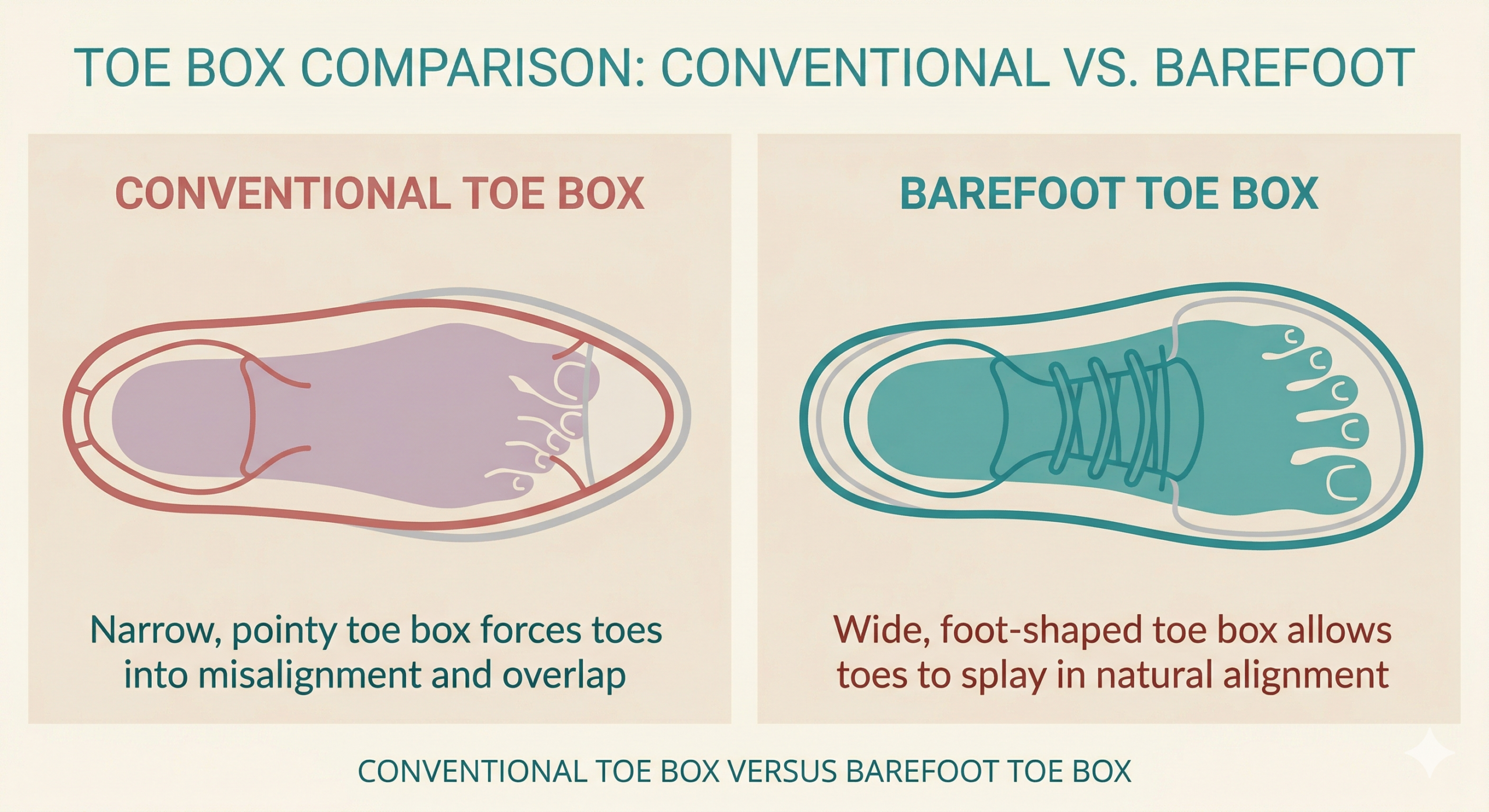
- A wide toe box.
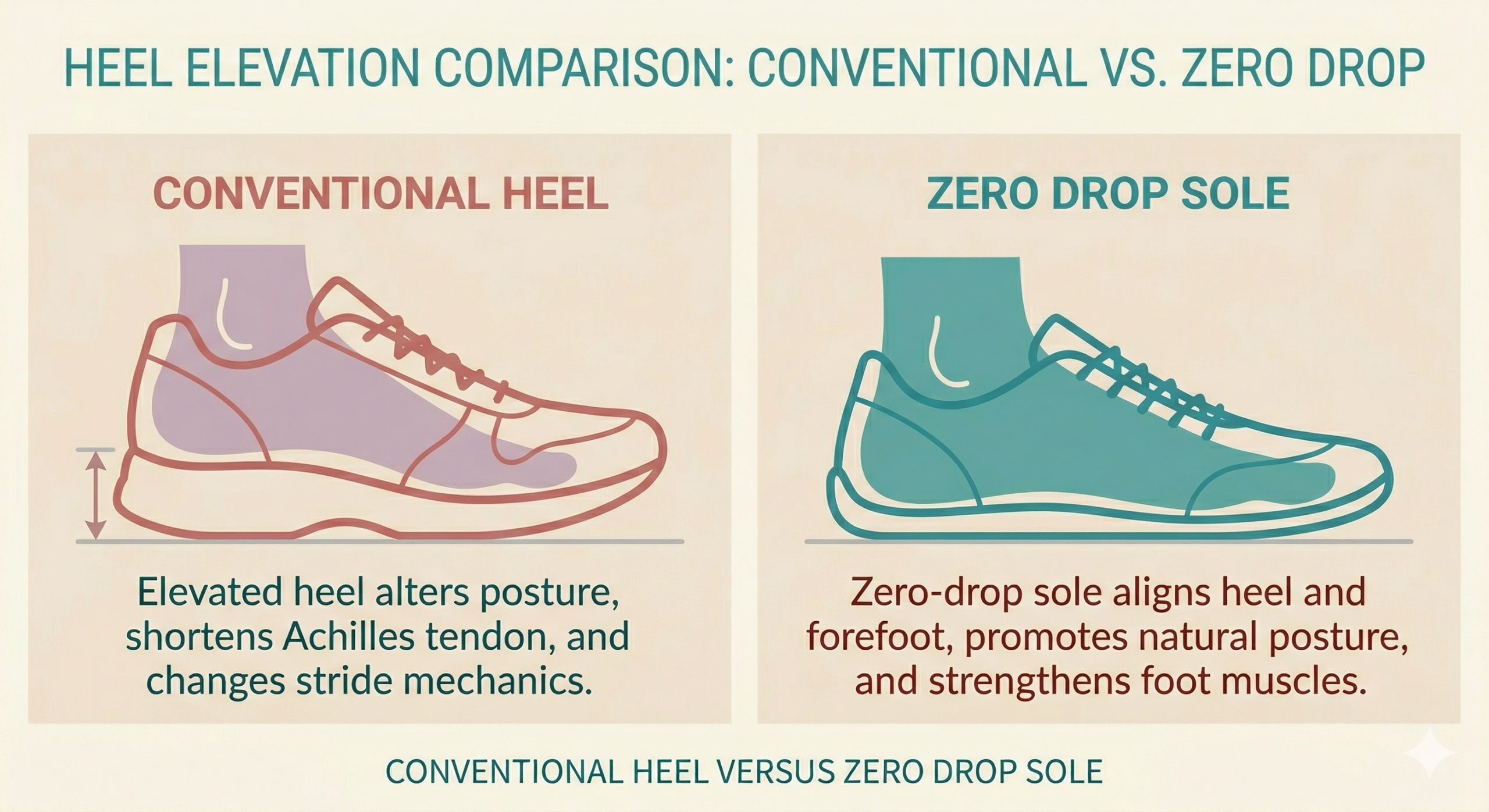
- Zero drop (no heel elevation at all).
- Thin, flexible soles.
Let’s discuss why each of these are critical and why they might benefit us:
Other Features of Barefoot Shoes
No arch support. Barefoot shoes should not have any raised area to “support” the midfoot. Again, this support acts as a cast and limits muscle activation, which can result in weak and dropped arches.
No toe spring. Toe spring can be seen in modern athletic shoes; the tip of the shoe turns up, allowing the wearer to ‘rock’ their foot when moving. This compensates for the sole stiffness and reduces the need for the foot muscles to engage. To avoid weakening feet we want these muscles in use, hence toe spring is seen as undesirable.
Transition shoes? Some shoes compromise on the barefoot criteria and target those who may want some aspects but not others. Even ‘fully barefoot’ brands vary in how minimal they are. ‘Barefoot friendly’ or ‘transition shoes’ keep some aspects conventional shoe design (e.g., thicker soles, but still zero drop and wide toes). While these may be useful for some, they are not a necessity for most people, who can transition simply by building up time in fully barefoot shoes.
Should I Wear Barefoot Shoes?
Many people report improved foot strength, improved balance, improved posture, improved spatial awareness (proprioception), and even an improvement in certain foot/leg pathologies like bunions, shin splints, and fallen arches. More and more evidence supports the health benefits – see sources at the bottom of this page.
The reason shoes are not foot shaped is down to fashion: while impractical, pointed and heeled shoes became popular, despite their tendency to generate bunions. Stiff or padded shoes provided little benefit outside of a few niche uses or medical issues – always follow the advice of your doctor!
While barefoot shoes for children can be commonplace in some countries, people later switch their children over to pointy and stiff conventional shoes. Barefoot shoes benefit all ages, even if you are elderly and have been in conventional shoes your entire life. There is the caveat of how to make the switch…
Where do I Start? Can I just start wearing them?
I would recommend you start by acquiring a pair of barefoot shoes! Any will do – a cheaper pair will work just fine as an initial investment in your foot health.
You can start wearing them right away, but a gradual transition is strongly recommended to avoid injury:
- Wear them around the house for short periods.
- Start with short walks and build up time and distance gradually.
- Introduce running or sports slowly.
The reason you should initially take it easy is because your feet have likely become deconditioned after years in restrictive shoes. Going all in straight away can cause discomfort and injury as your feet need to adjust slowly to using muscles in a new way. Just like with strength training, you need to progress slowly to ensure your muscles, ligaments and tendons all adjust. You may also need some time to get used to the sensation of being able to feel the ground’s texture.
You can practice foot strengthening and flexibility exercises to further assist your adaptation. For those short on time and patience, simply wearing barefoot shoes will be sufficient to strengthen your feet. If you run into issues during the transition, supportive or rehabilitative exercises can be of extra importance. Just like when training new muscles, a little bit of discomfort is not unusual and goes away as feet strengthen and adapt.
Myths and Concerns on the benefits of barefoot shoes
- “Barefoot shoes cause injuries”.
You might have heard worrying stories about people injuring themselves by wearing barefoot shoes. This is why the transition period is important! This is particularly important for hiking, walking long distance, and running. The risk of injury is low if you transition gradually and the potential benefits outweight it for most people.
- “Aren’t they just a fad / gimmick to sell overpriced shoes?”
They have been around for a long time. Foot shaped shoes were a concept marketed decades ago that have only gained more popularity on the modern world recently. I myself have been wearing barefoot shoes exclusively for almost a decade, and other have for even longer. Enthusiasts are excited to see mainstream attention being given to minimalist footwear.
The reason pointy, narrow, stiff shoes have become more popular is complex and a topic for another article. Pointy shoes used to be a status symbol, for example. And as we know, just because something is conventional or popular doesn’t mean it is optimal and good for health.
Due to the niche nature of barefoot, and often high build quality (e.g., many are made in Europe or the USA), prices can be higher than the mass produced shoes made on conventional pointy lasts in most shops. While many exquisite shoes can be bought, there are cheaper alternatives that can be purchased from Chinese manufacturers. The market has exploded and will only continue to offer more variety now that their popularity is increasing.
- “Won’t thin soles wear out sooner, making them a poor investment?” / “I don’t want to feel every bump underfoot!”
Many manufacturers use high quality, robust soling materials such as Vibram soles. These help prolong the life of the sole, while maintaining flexibility and thinness. They will wear through faster than a huge 4cm thick sole, of course, but the benefits of having a thinner sole are multitude and outweigh this downside. The wear patterns on conventional shoes often reflect improper gait, causing uneven wear patterns that further exacerbate the gait issues.
Remember, the thin soles are a beneficial feature, not merely a money making grab.
At first it’s going to take some getting used to the increase in sensation of being able to feel the ground. With time, this becomes normal and even desirable. Going back to thick soles will feel strange. Barefoot shoes can come in varying sole thicknesses, with some thicker ones coming in at 1cm and not proving a huge amount of ground feel. Some are designed specifically for hiking/running on rocky trails, where the thinnest soles might be uncomfortable for most people. You may find you crave thinner soles further along your barefoot journey, as is often the case.
Removable insoles (make sure they are flat, so the shoe remains zero drop) can help increase stack height and increase insulation from the ground. This has the benefit of being removable should you want to have more ground feel later on.
- “I buy them for my kids, but surely I don’t need them too as my feet are fully grown?” / “Why do kids need special shoes? I want to buy from a normal shop”.
While it is critically important that developing feet are able to function correctly, kids are not the only ones that benefit. It’s never too late to see results from strengthening feet, improving body alignment, and improving balance (think of the number of falls in the elderly, for example). Formerly flat feet can develop more of an arch. Squashed toes can splay out in comfort and improve balance.
Putting children in barefoot shoes is a relatively easy choice to make to set them up for success. Budget brands and a thriving second hand market mean it is more affordable and accessible than ever before. Some traditional retailers do stock barefoot style shoes (sometimes they are under the pre-walker label) and some fashion retailers are starting to stock youth barefoot shoes, too.
- “I dislike the aesthetic – they look like clown shoes.”
I think everyone feels this way to a certain degree at the beginning, simply because we’re not used to seeing foot-shaped shoes. Logically, of course foot shaped shoes make sense! But we are conditioned to find the conventional look of point toes normal. Women are conditioned to think they look unappealing or unprofessional without a heel. The only way this will change is if people choose comfort and function over conditioning. It’s easier nowadays due to the huge range of styles available, ranging from formal flats, loafers, tall boots, etc. There are plenty more fashion forward options available.
Many people report finding narrow-toed shoes displeasing to look at after their eye adjusts to the ergonomic shape of barefoot shoes. Another factor to consider is that a “switch” to barefoot shoes doesn’t have to be all-in. Going barefoot and wearing minimalist shoes part-time will provide some of the benefits, and you don’t have to rid yourself of your current shoe collection. Most people find that they struggle with wearing conventional shoes once they get used to barefoot shoes – this can be because they are not acutely aware of how shoes should fit and because their feet have had space to unsquash themselves.
Quick Takeaway: Barefoot shoes allow natural foot movement. Conventional shoes restrict toe splay and foot function. Transition gradually to avoid injury. Benefits include improved strength, balance, and awareness.
Evidence
Research is still developing as there is growing interest in how footwear impacts foot strength and biomechanics. Below are some relevant research links regarding minimalist shoes:
Foot strength
- This study shows that foot strength increases by, on average, 57.4% (p < 0.001) after six months of daily activity in minimal footwear.
- “Endurance running in minimal support footwear with 4 mm offset or less makes greater use of the spring-like function of the longitudinal arch, thus leading to greater demands on the intrinsic muscles that support the arch, thereby strengthening the foot.”
- “Foot exercises and minimalist shoes may be appropriate to increase foot strength and to induce biomechanical changes during dynamic tasks.”
Foot shape
- “Current data suggests that footwear that fails to respect natural foot shape and function will ultimately alter the morphology and the biomechanical behaviour of the foot.”
- “This verifies our hypothesis that HV might be developed by wearing shoes.”
Stability and Proprioception
- “Participants were more stable during standing and walking in minimal shoes than in conventional shoes, independent of visual or walking condition.”
- “Wearing minimal shoes might be more beneficial for stability and physical function in older adults than wearing conventional shoes.”
I hope you have found this overview useful. If you have any questions or comments, always feel free to get in touch by clicking here.