If you understand a few things about fit, you can waste so much less time returning shoes and being stuck in decision paralysis. This guide will help you understand your foot form and how to spot your perfect shoe.
Ad/Affiliate Disclosure:
This page contains affiliate links. If you buy something through one of these links, I may receive a commission at no extra cost to you.
Getting to Know your Feet
Taking the First Measurements
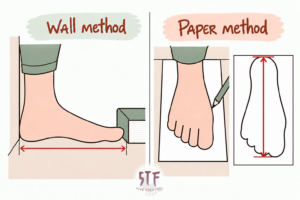
Let’s jump straight in with Length and Width. Two easy parameters to measure. There is information on how to measure these in the Quick Start Guide, but I will recap the paper tracing method for this barefoot shoe fitting guide below:
- Get a sheet of paper that is longer than your foot (thin cardboard is fine too. Thicker can distort the tracing when placing weight on it).
- Place the paper on a (preferably) hard floor, pushed up against a flat surface (like a door or wall) and step onto it. Make sure your heel is back against the wall or other flat surface.
- Trace around your foot, keeping the pen or pencil vertical.
- Measure the distance from heel (the end of the paper) to the longest toe to get your foot length. Measure the widest portion of your foot to get the foot width.
This method can work for kids that can stand, too. Make sure you measure both feet, as discrepancies are common. Use the largest foot’s measurement to ensure they fit the bigger foot.
You can use special tools to measure your feet, such as a foot gauge that looks like a board with a slider (e.g., this one for kids from BGreater) or my personal favourite the Plus12 (here, also available elsewhere from resellers). The Plus12 is unique as it allows you to measure the interior length of a shoe, saving you the guesswork on whether a shoe is actually the right size for your child. Many foot gauges come in differing size ranges, from children’s to adults.
Forget traditional shoe sizes, as they are not accurate and vary between manufacturers. Always check a size guide, where available. It will list something like the interior length, insole length, or sole length (for sandals). Sometimes they will provide recommended foot sizes for each size. Sometimes they will offer printable templates on which to place your foot to estimate size.
Now you have your foot length, you can check manufacturer sizing charts that are available on their websites.
Barefoot Shoe Fitting Guide: Navigating Sizing
Below is an excerpt of a size guide attached to a barefoot shoe listing from an Adults Tipsietoes Trainer Model:
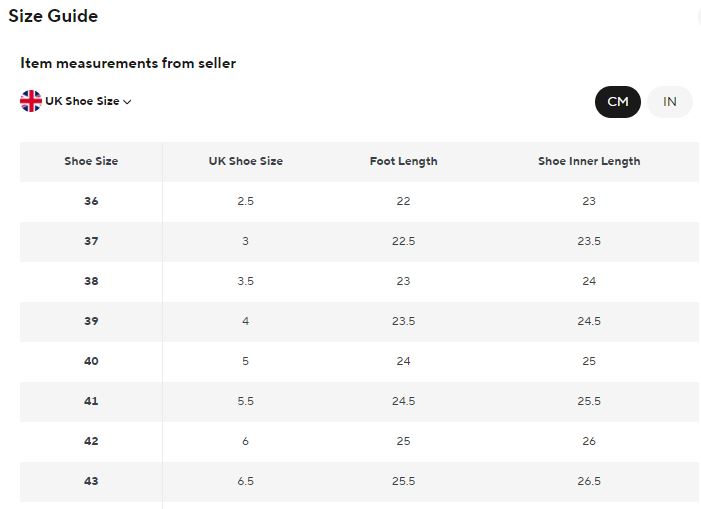
Note that the EU shoe size and UK shoe sizes in the above chart do not correlate as you would expect. A size 43 is typically a UK 9, not a 6.5. It is best to ignore these sizes where possible and just focus on the actual measurements. For sellers on direct-from-China platforms like Aliexpress, this is a very common issue.
Let’s see the importance of some values listed above, and others that may be provided by other brands:
- Shoe inner length. For adults in a closed toe shoe, you’re looking at around 1cm of extra space – perhaps down to 0.7cm or up to 1.5cm extra, depending on preference and how well your foot shape matches the toe box (we will get into that later).
- Foot length. The manufacturer’s opinion of which foot size to buy based on your foot, after adding their own estimate of wiggle room. In the above size chart, the seller recommends an extra 1cm of space, which is sensible. Fit is personal, so you may disagree based on preference and buy a different size.
- Insole length. Should be similar to shoe inner length, but may be a bit shorter as they don’t tend to be a perfectly exact fit.
- Japanese Shoe Size. Japan uses a “mondopoint” system that measures foot length in centimetres. I.e., a 27cm long foot is Japanese size 27. While more intuitive than the systems of the UK/EU/US/Etc. the inner length manufacturer’s measurement should be prioritised.
- EU shoe size. Tends to be more reliable than the UK/US/Etc. systems, but can vary wildly still. It is a unisex, continuous sizing, which makes it simpler.
- UK shoe size (and other countries too). Simpler than the US system as it is unisex. Complicates itself with children’s sizing re-using numbers from the adults sizing. Not standardised well, so varies quite a bit.
- US shoe size. Many of the same downsides of the UK system, as well as having different men’s and women’s sizing systems. Best avoided when trying to estimate whether a shoe will fit.
Templates
Some brands provide printable templates on which to place your foot, e.g., Earthrunners. It is best to fold along the back heel line and place the template on a hard floor against a wall or solid, flat surface. Then you can place your foot on the template with your heel back against the wall.
Putting the back of the template ensures that your heel isn’t extending back beyond where the back of the sandal or shoe would be, giving a false estimate of fit. Follow any guidance on the manufacturer’s page on how to determine fit, and of course double check the measurement of the template to make sure your printer has printed it to the correct scale.
Foot Scanning
Some websites can use a scan of your feet to estimate size. This involves taking a photograph of your foot against a sheet of paper to provide a size estimate. One retailers that offers this service is Vivobarefoot, using Volumental’s FitTechTM AI technology. Select a model and check out the sizing guide to test it out. I would still verify measurements against your own, rather than solely relying on the tool.
There are also in-person 3D foot scanning technologies, many of which are focused on the high end runner’s market. The presence of these in ‘normal’ shoe or sports shops are to primarily drive sales for the conventional shoes they retail, so be aware of this and don’t get pressured into buying shoes just because they’re available in-store.
Know Your Toe Profile! One Huge Factor in Finding a Perfect Fit in Barefoot Shoes
Toe shape can be classified with the ‘classical art’ taxonomy, e.g., an ‘Egyptian foot’. The terms refer to the historical cultures in which that foot shape was commonly depicted in art. See below for the main types:
- Egyptian – Big toe is longest and other toes taper down, giving a sloped toe profile.
- Greek – Second toe is longest, with the ‘big’ toe being shorter, giving more of pointed toe profile. The second toe is also referred to as Morton’s toe.
- Roman – The first 3 toes are longest and equal length. The last two toes are smallest, giving the effect of a plateau then a slope.
- Others – Some find they don’t neatly fit into one of the above 3 categories, so they use other ways of describing their toe shape. e.g., Square toes, where the toes are all of roughly equal length. There is also German, similar to the Egyptian toes, but the smaller toes are less sloped, giving a squarer profile.
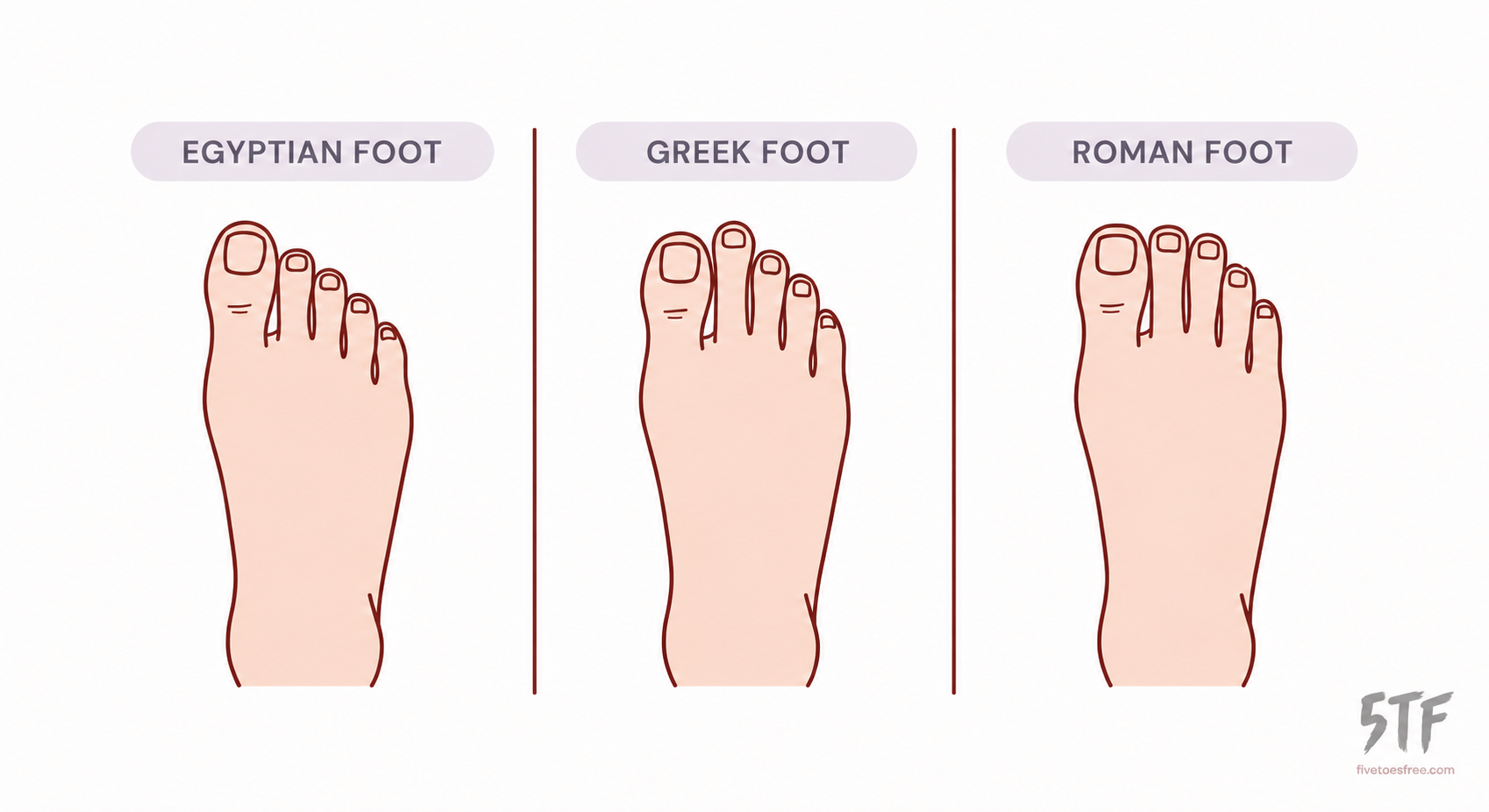
Egyptian shaped feet are the most common, which is why lots of barefoot brands cater to this shape primarily.
After gaining some understanding of your toe profile, what do you do with this information? Well, different brands tend to have different shaped toe boxes. Some within-brand models also differ in their toebox shape! Further below will be a description of brands and examples of the foot shapes they best cater to.
Getting a shoe that comfortably accommodates your foot without leaving too much space or too little is key to getting your ideal fit. This is best achieved by picking footwear that matches your toe shape the closest.
Width and Volume – Important Spatial Aspects!
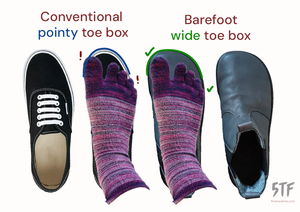
When we speak about ‘wide’ feet in conventional shoes, often the toe box is disregarded. It is common to see shoes that are wide only in the heel, mid-foot, or across the ball of the foot, still not providing vital toe-splay room. This is why seeking ‘wide’ conventional shoes isn’t a solution: pushing the big toe out of alignment while creating space at the ball of the foot is a recipe for bunions.
While many of us do vary in width across other areas of the foot, the width of the toe box is a key factor in barefoot shoes. It is the one thing that allows toes to remain in (or rediscover) natural alignment. Some people joke about having “pizza feet“, which are narrow at the heel and wide at the toes, resembling a pizza slice! While narrow in the rear of the foot, many people need increased width at the front.
Those who have worn conventional shoes may have toes with little space inbetween. You can get away with narrower toe boxes as a result, but remember that giving your toes room to function will mean they may spread! Soon you may need more width.
Foot volume refers to how much space is needed in the shoe. A high-volume foot requires more space and height, while a low volume foot may appear flatter or narrower, requiring less space. If you find yourself lacing shoes tight and slip-ons feel sloppy, you likely have a lower volume foot. On the other hand, if you struggle to get sandals to fit across your foot, have a high instep, or struggle to get your feet into shoes, you may have higher volume.
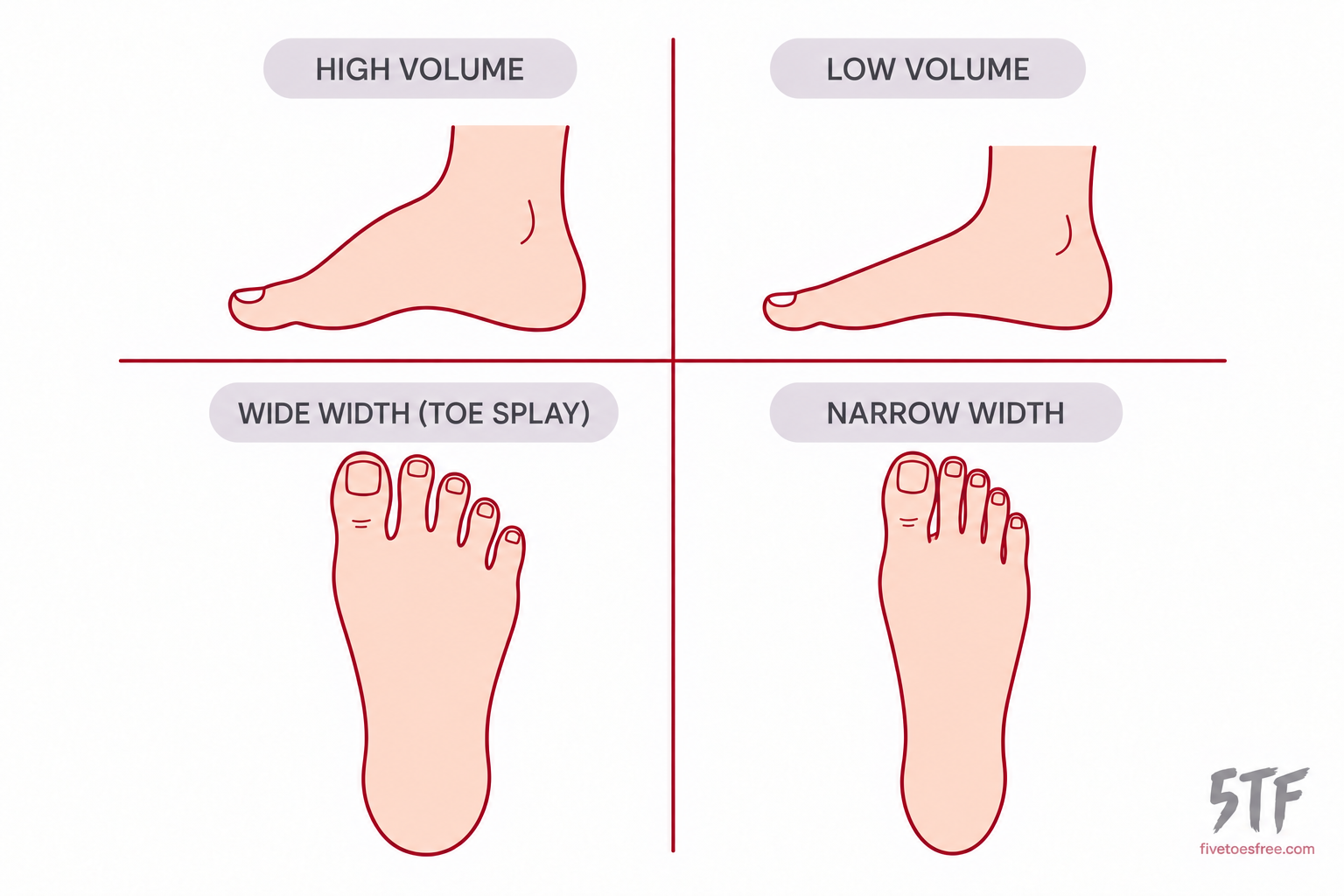
All of this information on categorising feet is useful when referring to reviews or lists that describe how the shoes will fit. See further below for some brand suggestions!
Some Brands and the Type of Feet They Fit:
| Brand | Example Model | Best Suited For |
|---|---|---|
| Be Lenka | Core trainer | Egyptian. Moderately wide toe box that slopes towards little toe. Mid Volume. |
| Shapen | Orchid sandal | Egyptian. Moderately wide toe box that slopes towards little toe. Mid to low volume. |
| Tipsietoes | High top leather trainers | Egyptian and Roman. Moderately wide toe box, squarish shape with some sloping. Mid volume. |
| Peerko | Go boot | Egyptian. Moderately wide toe box that slopes towards little toe. Mid volume. |
| Freet | Mudee 2 boot | Egyptian. Wide toe box that slopes towards little toe. Mid to high volume. |
| Vivobarefoot | Tracker Forest ESC boot | Greek. Toebox slopes slightly on both corners. Low volume. |
| Groundies | Zero women’s trainer | Greek. Toebox slopes slightly on both corners. Mid to low volume. |
| Tonglepao | Leather Chelsea boot | Roman and Egyptian. Most models are square toed and wide. Volume is model dependant, on the lower side. |
| Wilding | Tanuki Niji trainer | Roman. Toebox is squared off, but only narrow to moderate width. Volume very model dependant. |
| Softstar | Primal Runamoc trainer | Very model dependant. Extra wide toes with ‘primal’, and pointy with ‘regular’. Mid to low volume. |
What’s Underfoot: Sole Thickness and Stack Height!
Stack height is the height of the material between your foot and the ground. Thicker soles and insoles = increased stack height. Preference for thicker or thinner soles is somewhat personal. Some people prefer thicker soles, as they’re used to the thick, cushiony soles of conventional shoes. Over time as their feet adapt to the new sensations, they tolerate or crave thinner soles for the ‘barely there’ shoe feeling.
This isn’t everyone’s experience, and insoles can be an easy way to modify your changing preferences over time. Some barefoot retailers sell or provide insoles for their own shoes, while some companies do make flat and wide-toed insoles that complement the barefoot philosophy. Some examples below:
- Nothsole – make barefoot shape insoles that will fit a wide range of barefoot shoes (may require some cutting).
- Wildling – have a variety of materials that fit perfectly in their own shoes.
- DIY! – If you find some flat, flexible insoles you can buy them in a larger size and trim them to fit a more barefoot shoe shape.
Sole thickness / Stack height can vary by brand, model, and even within model (if different thicknesses are offered, usually sandals only). Thinner soles are usually more lightweight and flexible. Manufacturers often use quality soling materials to prevent them wearing through too quickly, e.g., Vibram rubber soling.
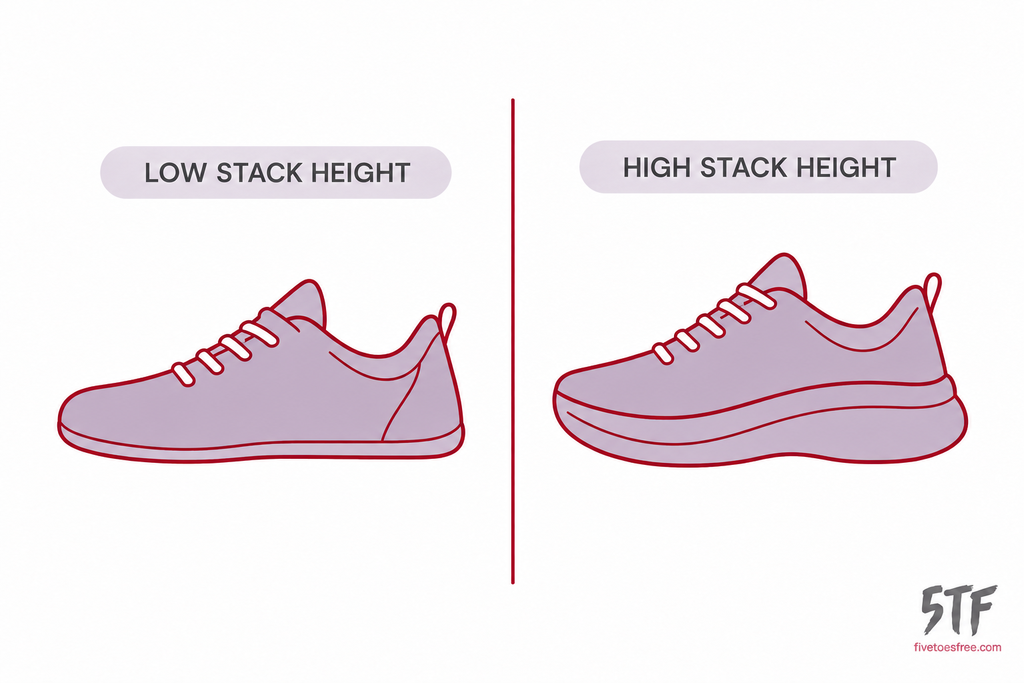
The thick, squashy soles of conventional shoes are a bit of a false economy, as the foams they are made with often wear down rapidly and make an uneven shoe. Thinner soles also offer more ground feel, meaning increased proprioception (sense of position and movement in space). Some may find thinner soles fatigue or make their feet sore at first, so prefer the increased protection offered by thicker soles.
Below are some examples of brands and models with their sole thickness:
- Wildling – One of the thinnest. E.g, without insole removed, the Tanuki’s stack height is 2.5 or 3.5 mm (depending on shoe size).
- Lems – One of the thickest. E.g., the Boulder boot has a stack height of 10mm.
- Most other brands are in between these numbers, with stack heights usually totalling 3-8mm. Models of course vary within brands.
In Summary (TL;DR) – the Recipe for Success:
- Get your length (and possibly width). Check this against any size guide for a specific brand/model.
- Know your toe shape and width (how much they splay). Compare to overhead or sole images of the shoes that show toe box shape.
- Think about volume. Some shoes appear more or less roomy in pictures. Reviews that mention volume aspects of feet/shoes are useful.
- Decide how thin or thick of a sole you can tolerate. Stack height is listed by some brands, but not all.
- Once you have your data, compare it to the shoes you like the look of. Check out people’s reviews to compare fit, check retailers photos, check their specs and size charts!