Whether you’re buying your first pair of barefoot shoes or comparing different brands, you’ve probably come across a lot of unfamiliar terminology. Zero drop, stack height, ground feel, toe spring… it can quickly become confusing.
The good news is that most of these terms are actually quite simple once you understand them.
This guide explains the most common barefoot shoe terminology in plain English, so you can confidently compare shoes and choose the right pair for your needs.
Table of Contents
Ad/Affiliate Disclosure:
This page contains affiliate links. If you buy something through one of these links, I may receive a commission at no extra cost to you.
Barefoot Shoes
Let’s start with the absolute basics. “Barefoot shoes” are designed to allow your feet to move as naturally as possible while still providing protection from the ground.
Although every brand has its own design philosophy, most barefoot shoes share several key characteristics:
- Wide, foot-shaped toe box
- Thin, flexible sole
- Zero-drop construction
The goal isn’t to make you walk barefoot, which you are more than welcome to – you don’t need shoes for that! Instead, the aim is to interfere with your natural movement as little as possible, while also providing the protectiveness (and societal acceptance) that comes with wearing footwear.
Click here to check out an article that covers the basics of barefoot shoes in more detail.
Minimalist Shoes
The terms minimalist shoes and barefoot shoes are often used interchangeably, but they aren’t always identical.
Generally speaking, minimalist simply means a shoe has fewer features than a traditional trainer. They might be considered a ‘transition shoe’, if the end goal is to move towards more barefoot aspects.
Some minimalist shoes still include:
- Slight heel elevation
- Narrower toe boxes
- Thicker cushioning
- Rock plates
- Extra stability features
Most barefoot shoes are minimalist, but not every minimalist shoe meets the characteristics many barefoot enthusiasts look for. Most people use the terms totally interchangeably, just be wary of terminology used by manufacturers or retailers. It’s more useful to look at their individual features than the label used by the manufacturer.
Zero Drop
One of the most common terms you’ll encounter is zero drop. This means your heel and toe are at the same level and there is absolutely no ‘heel’ on the shoe. Your Achilles tendon is therefore not in a shortened position.
Traditional running shoes often have a heel that sits 8–12 mm higher than the front of the shoe, hence a ‘drop’ from heel to toe.
Many people choose zero-drop footwear because it encourages a more natural standing posture and walking gait, much like actually being barefoot.
Heel-to-Toe Drop
Closely related to zero drop is heel-to-toe drop. For a true barefoot shoe, this should be zero. Some brands that manufacture a true barefoot line also manufacture models with a slight heel-to-toe drop, so look out for this.
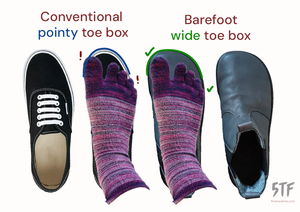
Toe Box
The toe box is simply the front section of the shoe where your toes sit.
In many conventional shoes, this area narrows sharply towards the front.
Barefoot shoes are designed with a much wider toe box, allowing your toes to spread naturally rather than being squeezed together.
A wide toe box is one of the key defining characteristics of barefoot footwear.
Foot-Shaped Design
You’ll often hear brands describe their shoes as foot-shaped.
Unlike conventional shoes, which are frequently shaped more like a pointed fashion shoe than an actual foot, a foot-shaped shoe follows the natural outline of your foot.
This usually means:
- More room around the toes, less rubbing
- Less tapering towards the big toe, less bunion formation
- Better stability
Remember that “foot-shaped” isn’t a regulated term. One company’s idea of foot-shaped may still be much narrower than another’s. It is also highly personal depending on your foot shape: click here for more in-depth information on how to find a shoe perfect for your foot shape.
Stack Height
Stack height refers to the total thickness of the sole between your foot and the ground.
A shoe with a 4 mm sole has a much lower stack height than one with a 25 mm sole. Most barefoot shoes come in at under 10mm stack height.
Lower stack heights generally provide:
- Better ground feel (increased proprioception)
- More flexibility
- A closer-to-barefoot experience
Higher stack heights offer more protection and cushioning but reduce sensory feedback from the ground and can create instability.
Shoes like Wildlings have some of the lowest stack heights, while certain Lems models, like the boulder boot, tend to have higher stack heights (while still being considered barefoot).
Ground Feel
Ground feel describes how much information you receive through the sole of the shoe.
Shoes with excellent ground feel allow you to notice:
- Small stones
- Changes in terrain
- Surface texture
- Uneven ground
Many barefoot enthusiasts value good ground feel because it can encourage more careful foot placement and improve awareness of the surface beneath you. It may be something you will find uncomfortable at first due to the new sensations, but will eventually come to appreciate. Conventional shoes may in comparison feel ‘dead’ and restrictive.
Sole Flexibility
A genuine barefoot shoe should flex easily with the movement of your foot.
The sole should bend naturally at the forefoot and ideally twist without much resistance.
One simple test is to see whether the shoe can be folded or twisted comfortably by hand.
Rigid shoes interfere with muscle usage when walking, which is why your foot strength will improve on switching to barefoot shoes.
Toe Spring
Toe spring refers to the upward curve found at the front of many conventional shoes.
This design helps the shoe roll forward during walking, as the rigidity of the sole will prevent the foot from flexing at the forefoot. It aids in a ‘rocking motion’.
Many barefoot shoes minimise or eliminate toe spring so the shoe lies flatter against the ground. This encourages a more natural toe position when standing and walking. The flexibility of the shoe means you don’t need to rely on rocking your foot with a stiff sole.
Cushioning
Not all barefoot shoes are equally thin.
Some brands produce shoes with:
- Virtually no cushioning
- Moderate cushioning
- Thick, but still “zero drop” cushioning
Choosing the right amount depends on your preferences, walking surfaces and experience level.
More cushioning generally reduces ground feel while increasing comfort on hard surfaces. Different soling materials provide different feels in terms of sponginess, even at the same stack height.
Rock Plate
A rock plate is a thin protective layer built into some trail shoes.
It helps prevent sharp rocks from pressing into the foot.
You’ll most commonly find rock plates in trail running footwear rather than everyday casual shoes.
Some barefoot hikers appreciate the added protection, while others prefer maximum ground feel.
Outsole
The outsole is the part of the shoe that contacts the ground.
Different outsoles are designed for different environments.
Some prioritise:
- Grip
- Durability
- Flexibility
Trail shoes often use deeper lugs for improved traction, while urban shoes typically have flatter tread patterns.
Lugs
Lugs are the raised sections of rubber on the outsole.
Deeper lugs provide better grip in:
- Mud
- Loose soil
- Wet grass
Shallower lugs are often quieter and more comfortable on roads and pavements. Thicker lugs offer a more sporty, rugged look shallower lugs appear more polished and formal.
Upper
The upper is everything above the sole.
Materials vary considerably between brands and may include:
- Leather
- Knit fabric
- Mesh
- Canvas
- Synthetic textiles
The upper influences breathability, durability, flexibility and water resistance. Natural materials tend to afford a higher price tag, while plastic shoes tend to be cheaper. Preference for synthetic / natural / vegan options can be accomodated by the huge variety of brands and models.
Breathability
Breathable shoes allow heat and moisture to escape more easily.
Mesh or lightweight natural fabrics generally provide the best airflow and are popular for summer walking and running.
Leather usually offers greater durability and weather resistance but can be warmer in hot conditions.
Synthetic leathers and other thicker, plastic uppers can be less breathable and uncomfortable in warm and humid conditions.
Waterproof Membrane
Some barefoot shoes include waterproof membranes designed to keep feet dry.
While these are useful in wet weather, waterproof shoes are usually less breathable than non-waterproof alternatives.
Many people prefer separate waterproof footwear for winter while wearing breathable shoes during warmer months.
Removable Insole
Many barefoot shoes include a removable insole.
Removing it can:
- Increase internal width
- Create additional toe space
- Improve ground feel
This also allows some wearers to customise the fit more easily, which is also useful for those starting out and initially wanting more cushioning. Some manufacturers provide thermal or other specialist insoles.
Conventional-shoe insoles are often not compatible with barefoot shoes. They are tapered at the toes and some have heel lifts themselves.
Transition Shoes
Transition shoes sit somewhere between conventional footwear and barefoot shoes.
They may include:
- Slightly thicker soles
- More cushioning
- Moderate flexibility
- Zero-drop construction
For some people, transition shoes offer a gentler introduction to barefoot-style footwear. Most people do just fine wearing true barefoot shoes and gradually easing into wearing them more and more.
Natural Foot Movement
One phrase you’ll frequently see in barefoot shoe marketing is natural foot movement.
While different companies define this slightly differently, it usually refers to allowing the foot to:
- Flex naturally
- Spread naturally
- Bend during walking
- Move without unnecessary restriction
Exactly what constitutes “natural” remains a topic of discussion, but the principle is generally to minimise interference from the shoe itself. Even in barefoot shoes, it may take some conscious effort to fix a gait that developed in a lifetime of conventional shoes. E.g., you may need to get used to taking shorter, gentler steps.
Proprioception
Proprioception refers to your body’s ability to sense pressure, position and movement via special receptors called mechanoreceptors.
Your feet, when given the opportunity, provide you with a wealth of information about the ground surface and your spatial position. This critical system is dampened when shoe cushioning interferes with the sensory input.
Improving your foot proprioception will improve balance, reduce injury risk and reduce clumsiness. Going barefoot, switching out of conventional shoes, and doing excercises that focus on foot proprioception are all ways to improve.
Frequently Asked Questions
What is the most important feature of a barefoot shoe?
Most people look for the following characteristics:
- Zero drop
- Wide toe box
- Flexible, thin sole
Together, these create the ergonomic barefoot-style experience.
Is more ground feel always better?
Not necessarily. Some people enjoy maximum sensory feedback, while others prefer a little extra cushioning for long days on hard surfaces or rough trails. If you’re tearing up rocky trails, you might need to compromise on some ground feel with thicker, tougher soles.
Do I need transition shoes before buying barefoot shoes?
Not everyone does. Some people comfortably switch straight to barefoot shoes, while others prefer a more gradual transition using slightly more cushioned footwear.
Where can I learn more about which barefoot shoes are right for me?
I’ve got you covered. Check out this handy article for an absolute beginners guide to jumping right in. For those with more patience and wanting something more in-depth, check out this guide on how to find the perfect fitting shoe. Both articles contain recommendations and examples of shoes you can buy now.